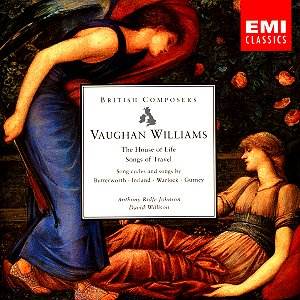
Vaughan Williams, Ireland, Gurney, Butterworth, Warlock: Songs
Anthony Rolfe Johnson (tenor), David Willison (piano)
EMI Classics CZS5 74785 2 (2 CDs)
The English art song—that peculiar beast. It occupies a strange territory in the recital repertoire, beloved by a certain breed of listener who treasures Housman and Rossetti and the Shropshire hills, yet often approached by singers with a kind of devotional reverence that drains the life right out of the music. This two-disc set from EMI’s British Composers series, recorded in the mid-1970s, captures Anthony Rolfe Johnson early in his career, navigating Vaughan Williams’s The House of Life and Songs of Travel alongside works by Ireland, Gurney, Butterworth, and Warlock.
The problem announces itself almost immediately.
Rolfe Johnson brings to these songs a certain fastidiousness—one might even say preciousness—in his treatment of the English language. Every consonant receives its due, perhaps more than its due. The “l” in “farewell” is lovingly lingered over. High notes are approached with visible (audible?) calculation, then “placed” with a crooning falsetto that substitutes delicacy for genuine emotion. In “Love’s Minstrels” from The House of Life, the phrase “the wan moon” becomes an exercise in careful vowel placement rather than an evocation of nocturnal longing. It’s all very proper, very artistic—and utterly uninvolving.
The tempi throughout are glacial. Rolfe Johnson and pianist David Willison seem determined to examine each song under a microscope, pausing at every turn of phrase, every harmonic shift. In Vaughan Williams’s Songs of Travel, they take a full four minutes longer than John Shirley-Quirk’s revelatory 1960s Saga recording. That comparison is instructive. Where Shirley-Quirk (with Viola Tunnard at the piano) keeps the cycle moving forward with the inexorable momentum of a true song cycle—think of the best Winterreise performances—Rolfe Johnson and Willison stop at every lamp-post. “Youth and Love” and “Bright is the Ring of Words” are spelled out syllable by syllable, the musical line fractured beyond recognition.
This isn’t to say that Rolfe Johnson lacks mastery. His voice in 1974–75 was in fresh condition, the tone pleasant if somewhat lacking in color. But technique without insight is mere carpentry. When moments of genuine passion arrive—the climax of “Death in Love,” for instance—the results are surprisingly effortless. The voice hardens, the pitch wavers, and what should be a moment of emotional release becomes simply unpleasant sound.
The other songs on these discs fare no better. Ireland’s The Land of Lost Content receives the same overly reverent treatment, as if these settings of Housman were liturgical texts requiring hushed veneration. Butterworth’s Six Songs from “A Shropshire Lad“ ought to have a certain masculine directness, a quality of stoic understatement—instead we get mincing affectation. The Warlock songs, which can sparkle with wit and genuine feeling in the right hands, sound merely quaint.
One might argue that this represents a certain authentic tradition of English song interpretation—that this is how these pieces were meant to be sung. I don’t buy it. The tradition of English song singing has produced genuine artists: Peter Pears, Janet Baker, Gerald Finley in more recent years. These singers understood that reverence for the text doesn’t mean embalming it. They found the architecture in Vaughan Williams’s long melodic lines, the genuine passion beneath Ireland’s pastoral surfaces, the darkness in Butterworth’s deceptive simplicity.
David Willison’s piano playing is competent but uninspired, dutifully plodding through accompaniments that can and should be much more than mere harmonic support. The recorded sound from Hornsey Town Hall and Northwood College is acceptable for the period—close but not claustrophobic, though the piano sounds a bit thumpy in the bass.
EMI’s presentation is adequate for a super-budget release. John Steane contributes a knowledgeable note, though one wishes for more critical perspective. The absence of texts is a major drawback, particularly for those unfamiliar with the poets. (Good luck finding Rossetti’s “Love’s Minstrels“—it’s actually titled “Passion and Worship” in most editions.)
The real tragedy here is that these songs deserve better advocacy. Vaughan Williams’s Songs of Travel can be genuinely moving—I know this from experience, from that Shirley-Quirk album that once reduced a young listener to tears. But you wouldn’t know it from this interpretation. Rolfe Johnson went on to have a distinguished career, particularly in Baroque music and Mozart. Perhaps that’s where his real strengths lay. These early recordings suggest that the English song repertoire, despite his native credentials, wasn’t really his territory.
For those exploring this repertoire, look elsewhere. The aforementioned Shirley-Quirk (if EMI ever sees fit to reissue it), or better yet, seek out Bryn Terfel’s Vaughan Williams, Sarah Walker’s Ireland, or Ian Bostridge’s Butterworth. They understand that English reserve doesn’t mean emotional vacancy, that clarity of diction needn’t come at the expense of musical line, and that these songs—written by composers who knew Ravel and Debussy, who understood Wagner and Brahms—deserve to be treated as serious music, not as museum pieces to be dusted off for garden parties.
Christopher Howell