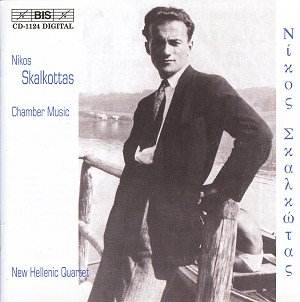
Skalkottas: Chamber Works
The New Hellenic Quartet, with Jan Bengtson (flute), Per Huderson (oboe), Per Billman (clarinet), Christian Davidson (bassoon)
BIS CD-1124 [65:16]
The rehabilitation of Nikos Skalkottas continues apace—though “rehabilitation” isn’t quite the right word for a composer who was never properly habilitated in the first place. Here’s a figure who studied with Schoenberg, developed a personal atonal-serial language of remarkable sophistication, and then returned to Athens to scrape by playing second violin in orchestras while composing masterworks in near-total obscurity. He died at forty-five. The world barely noticed.
This BIS release, intelligently programmed and superbly executed, makes a authoritative case for Skalkottas as something more than a footnote to the Second Viennese School. The String Quartet No. 1 from 1928—composed during his Berlin studies—announces a fully formed voice. Yes, the Schoenbergian influence is there in the rigorous contrapuntal thinking and the atonal idiom, but the sheer physicality of the string writing, the nervous energy that propels these three compact movements forward, sounds like nobody else. Skalkottas was a violinist himself, and it shows: these lines lie under the fingers with an almost tactile rightness, even as they twist through thorny chromatic thickets.
The New Hellenic Quartet plays with an intensity that never tips into shrillness. Their intonation in the quartet’s densest passages—and there are some truly knotty moments of four-part counterpoint—remains rock-solid. More importantly, they understand that this music, for all its chromatic complexity, needs to sing. The slow movement’s long-breathed lines emerge with genuine pathos, not the dutiful solemnity that sometimes afflicts performances of “difficult” modern works.
The Octet of 1934 shifts gears entirely. Here Skalkottas adopts what one might call his neoclassical manner—though that label doesn’t quite capture the music’s particular tang. The winds (flute, oboe, clarinet, bassoon) blend with the quartet in textures that recall Stravinsky’s Octet or perhaps the Hindemith of the Kleine Kammermusik, but the harmonic language remains distinctly Skalkottas: pungent, unsettled, refusing easy resolutions. The playing here sparkles. Per Billman’s clarinet in particular catches the ear with its woody, focused tone and impeccable articulation in the "scherzo"-like third movement.
Then comes the String Trio No. 2 from 1935, and we’re back in more austere territory. This is tough, uncompromising music—three instruments engaged in rigorous motivic argument across four substantial movements. The New Hellenic players (reduced to three for this work, obviously) never try to prettify what is essentially a severe intellectual construction, but they also refuse to let it turn abstract. The cello anchors the texture with a dark, resinous sound; the viola weaves intricate countermelodies that the microphones capture with admirable clarity.
The Zehn Stücke für Streichquartett offers relief—if that’s the word—in the form of ten miniatures, most under two minutes, some barely scraping past thirty seconds. Skalkottas composed these sketches around 1940, and they’ve become relatively well-known in the composer’s own arrangement for string orchestra (as Ten Sketches). In the original quartet version, they feel more intimate, more like private jottings. The three slow pieces in particular have a haunting quality, a strange melancholy that hovers between late Romanticism and something harder to name. The New Hellenic Quartet shapes these fragments with care, finding the through-line in what could easily sound merely episodic.
The disc concludes with “Geros Dimos,” a 1949 arrangement of a nineteenth-century song by Paul Karrer. It’s an encore piece, really—Skalkottas made it for his own Athens Quartet shortly before his death—and it shows the composer in his Greek Dances mode, wrapping folk-like material in sophisticated harmonic dress. Charming enough, though it hardly represents Skalkottas at his most essential.
BIS’s sound is exemplary: close enough to capture every expressive nuance, distant enough to preserve a natural acoustic. The Nybrokajen venue in Stockholm provides warmth without mushiness, clarity without clinical dryness.
This release—the second volume of the New Hellenic Quartet’s Skalkottas survey—confirms what the first volume suggested: we’re dealing with a major composer whose neglect is one of twentieth-century music’s more embarrassing oversights. The performances throughout are committed, technically assured, and musically penetrating. Anyone interested in the century’s chamber music ought to hear this disc. Strongly recommended.