
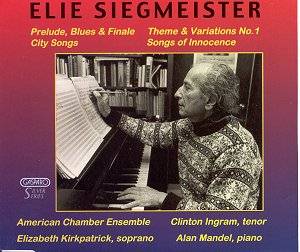
Elie Siegmeister: Chamber and Vocal Works
Gasparo GSS 2008
I confess to approaching this disc with more curiosity than expectation—Elie Siegmeister remains one of those American composers whose reputation hovers somewhere between regional importance and genuine neglect. This reissue from Gasparo’s catalogue offers a chance to reconsider that assessment. The results prove… complicated.
The Theme and Variations for Solo Piano (1932) announces itself with startling assurance. Here’s a twenty-three-year-old writing music of genuine harmonic grit—dissonant, uncompromising, built from materials that owe something to Prokofiev’s motoric drive and perhaps to Copland’s own Piano Variations of 1930. Both composers, after all, had studied with Nadia Boulanger, and you can hear her insistence on structural clarity even when the surface bristles with tone clusters and angular intervals. Alan Mandel plays with conviction, bringing out the work’s architecture without softening its asperities. The variations unfold with cumulative power, each transformation revealing new facets of a rather severe initial idea.
But then something curious happens across the rest of the program. Or rather, something curious fails to happen.
The Prelude, Blues and Finale (1984)—scored for two clarinets and piano—begins promisingly enough. Stanley Drucker’s solo clarinet in the opening suggests Varèse, that same sense of pitched sound emerging from silence like a geological formation. When the piano enters with its violent cluster chords, we’re in territory that feels genuinely exploratory. The problem arrives with the second movement. Despite its title, “Blues” offers only the most distant acquaintance with the blues idiom—a few flatted thirds, some languid rhythms that occasionally gesture toward jazz without ever committing to its syntax. The brief passages that attempt something like a jam session sound oddly stiff, as though the composer were working from anthropological field notes rather than lived experience. The "finale" recovers some momentum through austere clarinet counterpoint and virtuoso piano writing, but one senses effort rather than inevitability.
City Songs (1977) sets eight poems by Norman Rosten, and here I must speak plainly: the poetry considerably outstrips the music. Clinton Ingram sings with passion and technical command, but Siegmeister’s vocal lines remain resolutely angular, his harmonies refusing to settle into anything resembling repose. “Clouds” features appropriately wispy accompaniment—that much works. But the melodic writing shows little sensitivity to the natural inflections of English, the scansion of verse, the way words want to move in a singer’s mouth. One admires the performers’ dedication while wondering what they heard in these settings.
Which brings us to Songs of Innocence (1972, revised 1985). Elizabeth Kirkpatrick possesses a clear, focused soprano and obvious intelligence. She needs both, because Siegmeister’s Blake settings constitute one of the more puzzling encounters between major poetry and contemporary music I’ve experienced. Blake’s Songs demand—require—a certain transparency, a willingness to let the verse breathe. Instead, Siegmeister imposes his established harmonic language with what feels like dogged consistency: chromatic saturation, avoidance of cadential resolution, melodic lines that fight against rather than illuminate the text. The result isn’t so much a setting of Blake as an argument with him.
Gary Higginson’s original liner note (circa 1985) praises Siegmeister’s “consistency and yet variety of style“—a formulation that strikes me as diplomatically hedging its bets. What comes across more forcefully is consistency without sufficient variety. Having established a muscular, dissonant idiom in his early twenties, Siegmeister seems to have applied it across subsequent decades with little adjustment for genre, text, or expressive requirement.
The 1986 disc quality holds up reasonably well in this 1999 digital transfer, though the piano occasionally sounds a bit distant in the chamber work. Documentation includes all texts, though one wishes for more biographical context about the composer’s development.
In the end, this disc makes a case for Siegmeister’s technical command while inadvertently revealing the limitations of an insufficiently flexible musical language. The Theme and Variations deserves to be heard—it’s a substantial achievement. The rest? Curiosities for specialists, perhaps, but hardly the work of “one of our four most distinguished creative musicians,” as the notes rather breathlessly claim. One wonders who the other three might be.
