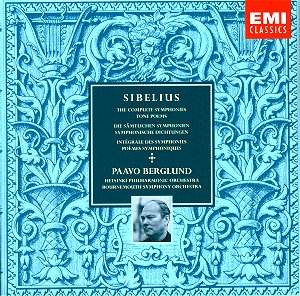
SIBELIUS: Complete Symphonies and Miscellaneous Works
Paavo Berglund/Helsinki Philharmonic, Bournemouth Symphony
EMI 5 74485 2 (8 CDs)
There’s something almost perverse about the way EMI has packaged this set—four symphonies from Helsinki, the other three from Bournemouth, the Helsinki Kullervo omitted in favor of the earlier Bournemouth one, tone poems scattered across three discs in an order that defies chronology, geography, or any other organizing principle I can fathom. And yet. Listen to these performances and the haphazard presentation matters not at all.
What matters is that Berglund, across seventeen years and two orchestras, achieved something rare: a Sibelius cycle that sounds as if the same man conducted the same ensemble in a single concentrated period. The timbral consistency is uncanny. The Bournemouth strings in 1972 and the Helsinki strings in 1987 produce the same lean, granite-like sonority—not the plush cushion of Karajan’s Berliners, not the nervous intensity Gibson coaxed from his Scots, but something cooler, more Nordic, more architectonic. When you’re four movements into Symphony No. 2 (Helsinki) and suddenly find yourself in the opening bars of No. 3 (also Helsinki), then jump to No. 4 (partly London, All Saints Church, Tooting of all places), the transition feels seamless. Only the recording venues shift; the interpretive vision holds steady.
And what a vision it is. Berglund has no interest in rhetoric for its own sake. Where Barbirolli—God rest him—would linger over a melodic curve until you thought your heart might break, Berglund presses forward with what sounds like inevitability but is really iron discipline. His first movement of No. 2 has been called slow, and by the stopwatch perhaps it is. But he establishes such a authoritative sense of rhythmic pulsation from the opening bars that the music seems to generate its own momentum, like a glacier—inexorable, unstoppable, terrifying in its patient force. When he does accelerate, as in the symphony’s closing pages, the effect is cataclysmic precisely because he’s held so much in reserve.
The Fifth receives similar treatment. This is not the heroic, brass-blazing affair some conductors make it. Berglund sees it as transitional, a step toward the compressed utterance of the Seventh, and he shapes it accordingly—powerful, yes, but with a strange inwardness, as if Sibelius were already beginning to strip away the last vestiges of late-Romantic gesture. The famous horn calls in the "finale" don’t blaze; they emerge from the texture with a kind of primal certainty, like rock formations revealed by receding ice.
Which brings us to the Sixth, where Berglund’s approach pays its richest dividends. How many conductors treat this symphony as a pallid interlude between the Fifth’s heroism and the Seventh’s apotheosis? Berglund presents it with unusual strength—the opening "Allegro" molto moderato sung out by the strings with real weight, the modal harmonies not ethereal but solid, built to last. He understands that this isn’t music about escape but about confronting the eternal in the quotidian. The slow movement achieves a kind of radiance without ever turning soft or sentimental.
The Seventh, then, becomes not a sudden leap into modernism but the logical conclusion of everything that’s come before. Berglund’s tempo relationships are impeccable—the great trombone theme neither rushed nor lingered over, simply stated with the finality of revealed truth. When the music finally winds down to its quiet close, you feel you’ve witnessed not a rendition but a process, something organic and necessary.—The miscellaneous works present a different challenge. Berglund’s granite-like approach serves the tone poems magnificently—Tapiola in particular, with its scarifying climaxes and sense of implacable natural forces, sounds definitive. The Oceanides emerges with unusual clarity of texture; you hear the individual instrumental lines that create the impression of shifting water rather than just a generalized wash of sound.
But what of the lighter theatre music? Here one might have expected Berglund’s sobriety to prove a liability. It doesn’t. He shapes these miniatures—the Swanwhite excerpts, the Pelléas et Mélisande suite—with remarkable delicacy, finding the necessary rubato without ever turning precious or over-perfumed. The “Scene with Cranes” from Kuolema (paired, inevitably, with “Valse triste”) has a haunting quality, the oboe solo exquisitely done. Only occasionally, as in some of the King Christian II music, does one sense that this essentially serious-minded maestro is working slightly against his grain.
The Kullervo presents a special case. EMI’s decision to include the 1970 Bournemouth recording rather than the 1985 Helsinki one seems vindicated by the results. True, the Estonian State Academic Male Choir on the later disc is magnificent, a vocal force of nature. But the soloists on the Bournemouth disc are superior—Raili Kostia’s rich, secure soprano infinitely preferable to Eeva-Liisa Naumanen’s effortful singing, and while Jorma Hynninen has his admirers, his tendency to bleat under pressure makes Usko Viitanen sound like a model of steadiness. More crucially, Berglund’s tempo in the long fourth movement is swifter in Bournemouth, and since this is early Sibelius, somewhat sprawling and not yet in full command of his symphonic powers, the extra forward drive helps enormously.
The Helsinki University Male Choir serves both recordings, and their sound—dark, focused, capable of genuine pianissimo—reminds you why Finnish male choruses remain the gold standard for this repertoire. When they enter in the third movement of Kullervo, the effect is electrifying even in the somewhat boxy acoustic of Southampton’s Guildhall.—About those acoustics: the Bournemouth recordings, made in the Guildhall between 1970 and 1978, offer wide stereo separation and considerable immediacy, though very occasionally at climaxes you sense the engineers backing off slightly to avoid distortion. The Helsinki recordings from the Culture Hall (1984–87) and that odd London session at All Saints