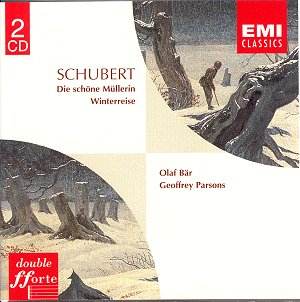
Schubert: Die schöne Müllerin, Winterreise**
Olaf Bär, baritone; Geoffrey Parsons, piano
EMI Classics (recorded 1986, 1988)
There are moments—rare ones—when a singer’s technical limitations become virtues. Olaf Bär’s voice, lighter and more pliable than the burnished instruments we’ve come to expect in these cycles, initially sounds almost too yielding for Winterreise. Too young, perhaps. But that’s exactly the point.
Listen to “Gute Nacht” and you’ll hear what I mean. Those shifts from D minor to D major—Schubert’s masterstroke of memory and delusion—Bär doesn’t just navigate them, he inhabits them. The voice brightens and dims like a lamp turned up and down, the timbre itself becoming an interpretive tool rather than mere sonority. Geoffrey Parsons, who understood this music’s architecture better than almost anyone, matches him with playing that never intrudes yet never merely accompanies. The piano part in “Des Baches Wiegenlied” becomes an actual stream, rippling beneath Bär’s heartbreakingly pure line.
Die schöne Müllerin suits him even better. The cycle demands a certain naïveté—not ignorance, but that quality of unguarded feeling that Fischer-Dieskau, for all his genius, sometimes intellectualized into submission. Bär’s “Am Feierabend” captures the young miller’s manic energy, that desperate need to impress through physical labor, without overplaying it. The legato stays clean. The words emerge naturally from the vocal line rather than being imposed upon it.
Where Bär falls short—and one must be honest—is in the darkest recesses of Winterreise. “Der stürmische Morgen” wants more heft, more chest voice, more sheer vocal weight than he can summon. The wanderer here sounds buffeted by winds he could actually withstand, when the music demands something more existentially threatening. And in “Der Leiermann,” that final devastating encounter, I miss the hollow, haunted quality that makes the hair stand up on your neck. Bär sings it beautifully. Perhaps too beautifully.
But then—“Die Post.” That sudden quickening of the pulse, that involuntary hope springing up despite everything. Bär catches it perfectly, the voice lifting with a brightness that feels utterly unforced. Parsons’s posthorn figures dance without becoming cute. This is interpretive intelligence of a high order.
The recorded sound from the Lukaskirche catches Bär’s voice with flattering warmth, though Abbey Road’s engineers positioned him slightly too close in the Winterreise sessions—you can hear him breathe, which isn’t always illuminating. The piano sounds magnificent in both venues, that crucial middle register where Schubert does so much of his psychological work coming through with ideal clarity.
EMI’s double-forte reissue makes this essential listening at any price. Bär may not displace the great recordings—Hotter’s shattering Winterreise, Prey’s incomparable Müllerin—but he offers something they don’t: the sound of a young artist growing into these cycles before our ears, bringing technical refinement to music that can die under too much polish. The partnership with Parsons alone justifies ownership.
These aren’t definitive performances. They’re better than that—they’re alive.