A Bass in Winter: Jules Bastin’s Unexpected Journey
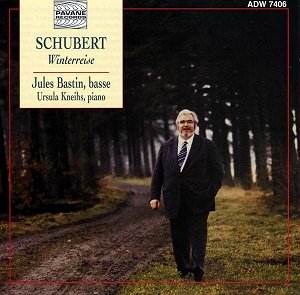
Here’s an oddity worth contemplating. Jules Bastin—that superb Belgian bass who made such delectable work of Leporello and Bartolo, whose comic timing could turn Don Pasquale into something approaching perfection—recorded Winterreise in 1978 at the Abbaye de Stavalot. The very idea seems improbable. This is not the terrain where operatic basses typically venture, and for good reason.
The voice itself is magnificent. Listen to “Wasserflut” or “Der Lindenbaum” and you hear a true bass—lean, focused, capable of that floating diminuendo that makes you hold your breath. Bastin’s instrument had uncommon flexibility for its weight, with secure upper extension and a legato line that many a baritone might envy. The timbre itself is exquisite, plush without being woolly, resonant without that hollow boom some basses cultivate. Ursula Kneihs provides sensitive accompaniment throughout, her piano work captured in a pleasingly clear acoustic that places both artists in proper perspective.
Winterreise makes demands that transcend vocal beauty. This isn’t Sarastro intoning wisdom or even Boris raging at his conscience. Schubert’s cycle—those twenty-four stations of romantic desolation—requires an intimacy, a psychological transparency that the operatic bass voice, by its very nature, rarely achieves. The protagonist isn’t a king or priest or comic servant. He’s stripped bare, wandering through a landscape that mirrors his dissolution.
Bastin’s Walloon background (he was French-speaking, not Flemish, as one correspondent helpfully noted) presents genuine obstacles here. The German text—with its hard consonants, its capacity for explosive emotional release—doesn’t sit naturally in his mouth. You hear it in “Gute Nacht,” where the words remain stubbornly exterior rather than seeming to well up from within. The diction is careful, even scrupulous, but it lacks that sense of the language being the singer’s natural medium for despair.
More problematic is the interpretive approach. Bastin sings these songs with operatic amplitude and polish. “Die Krähe” should chill; here it merely sounds handsome. “Der Leiermann” needs to scrape bottom, to find that zone beyond hope where the hurdy-gurdy man grinds out his terrible music. Bastin gives us vocal splendor instead—the phrase beautifully shaped, the tone unforced and pure. It’s rather like encountering a beautifully dressed stranger at a funeral; nothing is actually wrong, but something essential is missing.
Fischer-Dieskau recorded this cycle seven times, each an excavation of new depths. Hans Hotter brought Old Testament authority to it. Even Gerhard Hüsch in the 1930s, with his baritone’s warmth, found ways to suggest the abyss. Bastin’s traversal remains oddly exterior, a tourist in winter rather than winter’s victim.
The 1978 release captures the voice at its absolute prime—this must be acknowledged. For those who simply want to luxuriate in magnificent bass singing, divorced from dramatic context, this disc offers real pleasure. But Winterreise isn’t about vocal display. It’s about a man coming apart, and that requires a different kind of courage than Bastin brings to bear here.
Pavane’s reissue is competently done, the transfer clean. But the fundamental mismatch between artist and material remains insurmountable. One admires the ambition while regretting the result. For this journey, seek out Fischer-Dieskau with Demus (the 1965 DG recording especially), or better yet, the shattering Pears-Britten collaboration. Even Peter Schreier’s more lyric approach penetrates deeper than Bastin manages.
A noble failure, then. The voice is glorious. The interpretation never catches fire.