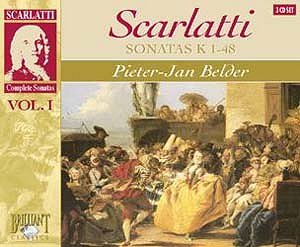
Scarlatti’s Keyboard Universe: An Ambitious Beginning
Pieter-Jan Belder
Domenico Scarlatti: Complete Keyboard Sonatas, Vol. 1
Sonatas K. 1–48
Brilliant Classics 99740 (3 CDs)
The Dutch harpsichordist Pieter-Jan Belder has embarked on what might charitably be called a fool’s errand—disc all 555 of Domenico Scarlatti’s keyboard sonatas. Only Scott Ross managed this feat before his untimely death in 1989, and his Erato traversal remains something of a sacred text for Scarlatti devotees. Yet here comes Belder, fresh from his creditable work on Brilliant Classics’ Bach edition, ready to spend the better part of a decade with these extraordinary pieces.
The question isn’t whether we need another complete Scarlatti. We probably don’t. The question is whether Belder brings something worth hearing to these first 48 sonatas—the Essercizi per gravicembalo published in London in 1738, the only collection Scarlatti himself saw through the press.
Belder plays a Dutch harpsichord with a robust, almost aggressive tone—none of that polite tinkle that makes some historically informed interpretation sound like a music box having a nervous breakdown. The instrument recorded in the Remonstrantse Kerk in Deventer has genuine weight in its lower register, and Belder exploits this fully. Listen to the famous Sonata K. 9 in D minor, where the left hand must thunder through those repeated bass figures while the right executes its acrobatic leaps. Belder doesn’t flinch. The articulation stays clean even when the tempo threatens to run away from him—which it occasionally does, though never disastrously.
What strikes me most about this first installment is Belder’s refusal to sentimentalize the slower pieces. The Sonata K. 32 in D minor, marked “Aria,” could easily become precious in the wrong hands. Belder treats it with directness, almost severity, letting Scarlatti’s extraordinary harmonic progressions speak without romantic overlay. There’s a whiff of the church artist in this approach—appropriate enough, given Scarlatti’s early career—but also a recognition that these pieces, however brief, are architecturally complete. They don’t need emotional scaffolding.
The faster sonatas present different challenges. Scarlatti’s rhythmic vitality—that peculiar mixture of Spanish guitar artistry, Italian opera, and pure keyboard imagination—requires a performer who can shift gears instantaneously. Belder manages this more successfully than not. K. 23 in D major crackles with the right kind of nervous energy, those hand-crossings executed with theatrical panache. K. 29 in the same key, with its relentless perpetual motion, sounds genuinely breathless rather than merely fast.
But—and there’s always a but—I wonder about the long game here. Ross recorded his complete set in a concentrated burst of activity, which gave his performances an almost obsessive coherence. You heard a single, penetrating intelligence working through these pieces in something approaching real time. Belder’s project will unfold over years, and while individual sonatas may benefit from this more measured approach, will the whole possess that kind of unity? Hard to say at this early stage.
Technical quibbles are minor. Occasionally Belder’s ornaments sound perfunctory, as if he’s checking boxes rather than genuinely embellishing. The notorious trill in K. 1 could use more spin. Some of the minor-key sonatas—K. 8 in G minor, for instance—would benefit from darker coloring, more dramatic chiaroscuro. But these are details, really, the kind of thing one notices on the fifth or sixth hearing.
The recorded sound itself is outstanding: present without being clinical, spacious without losing focus. The engineers have captured the harpsichord’s full tonal spectrum, from those percussive high notes that sound like drops of water hitting marble to the almost organ-like resonance of the bass.
Three hours of music spread across three discs for roughly ten dollars—the economics here are almost embarrassing. Brilliant Classics continues to show that budget pricing needn’t mean budget artistry. Whether Belder will maintain this standard across another dozen volumes or so remains to be seen. For now, though, this is serious Scarlatti playing at an absurd price. Ross’s set, when you can find it, costs ten times as much. Belder may not entirely displace the late master, but he’s certainly earned a place at the table.
I’ll be curious to hear where this project goes. These 48 sonatas suggest a musician with the stamina and intelligence to see it through. Whether he has the imagination to make 555 individual pieces cohere into something larger—well, ask me again in 2007.