The Young Rossini’s Farsa in Spirited, if Imperfect, Polish Hands
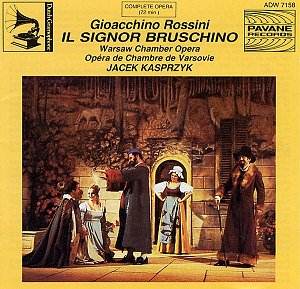
Here’s a problem that vexed me throughout this Warsaw Chamber Opera disc: how do you evaluate a interpretation that gets so much right dramatically while stumbling over basic matters of balance and vocal projection? The answer, I suppose, is that you acknowledge both—and in the case of this 1985 Il Signor Bruschino, there’s enough theatrical vitality to compensate for technical shortcomings that a more scrupulous producer might have addressed.
This was Rossini at nineteen, writing his last farsa before Tancredi and L’Italiana in Algeri arrived within months to change everything. The form itself—those swift one-act comedies that paired up for an evening’s entertainment—vanished almost as quickly as it had flourished. Which explains why Il Signor Bruschino, for all its charm and its catalogue of devices the mature Rossini would refine and deploy to devastating effect, remains a rarity on disc and in the house.
The overture announces itself with those famous tapped candlesticks—here the percussionists really whack away at their music stands—and Jacek Kasprzyk takes this as license for headlong tempos throughout. Sometimes it works. The recitatives, particularly, crackle with theatrical energy. Jerzy Mahler’s Gaudenzio tears through his letter-reading at a gallop that would leave most basses gasping, yet every syllable registers with expression to spare. It’s genuinely funny, which in Rossini is half the battle.
But those tempos exact their price. Kazimierz Myrlak’s Florville starts at a disadvantage—his tenor, pleasant enough in timbre, lacks the heft to cut through when the orchestra gets enthusiastic. And it does get enthusiastic, particularly in the early numbers where the microphone placement seems to favor instrumental clarity over vocal presence. Myrlak gradually asserts himself, finding more color and urgency as the opera progresses, but you sense him fighting the balance rather than riding it.
Jan Wolanski’s Bruschino, by contrast, needs no special pleading. His bass has that wonderful balloon-like quality—taut, resonant, ready to pop. The absurd “che caldo” repetitions become genuinely comic in his hands rather than merely tedious, and when he later denies recognizing his own “son” (the disguised Florville), the vocal leaping that Rossini demands sounds effortless. This is character singing of real distinction, the kind that makes you understand why these one-act pieces held the stage when they had performers who could inhabit them so completely.
The vocal timbres here are admirably distinct—essential in a farsa where confusion drives the plot. Mahler’s Gaudenzio has that deep brown bass-baritone color, darker than Wolanski’s, with a hint of pathos underneath the clowning. When the two basses combine in the trio with Myrlak, you get genuine textural variety rather than the muddy blend that can afflict recordings from this era. Dariusz Niemirowicz’s Filiberto adds a lighter bass to the mix, his innkeeper mischievous without sacrificing tonal quality in those rapid-fire plot-advancing exchanges.
Alicja Słowakiewicz gives Sofia the vocal glamour the role requires, though a slight shrillness creeps in at forte. Her “Ah, donate il caro sposo” has genuine feeling—that plangent cor anglais obbligato helps—and she manages some effective tonal variations within the number. But it’s in the ensembles that she really shines. The opening duettino with Florville has charm despite the balance issues, and her later duet with Gaudenzio proves what this recording does best: the singers listen to each other, respond to each other, create something larger than their individual contributions.
That quartet of Bruschino’s discomfiture—it’s a small marvel of ensemble writing, and the Warsaw forces deliver it with theatrical punch and musical precision. The combination of voices produces a result greater than the sum of the parts, which is exactly what Rossini’s ensemble writing demands. You hear the young composer already thinking in terms of vocal architecture, building structures that will support the comic action while giving each singer moments to shine.
The absence of a libretto translation is irritating—the detailed synopsis makes the plot sound even more preposterous than it is—and you’ll need the text to follow some of the quicker exchanges. Halina Górzyńska appears too briefly as the maid; her clear, bright soprano deserves more than the tiny role allows.
Richard Osborne called this “a small treasure trove of comic devices,” and he’s right. This performance, for all its imperfections of balance and occasional lack of vocal weight, opens that treasure trove with real theatrical flair. The orchestra plays with spirit under Kasprzyk, the recitatives have genuine dramatic momentum, and the comic ensemble work achieves what matters most: it’s funny, it’s musical, and it makes you want to hear the piece again. Not a great recording, perhaps, but an entertaining one—which in a farsa may amount to the same thing.