
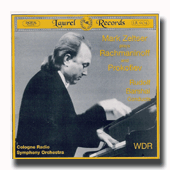
Mark Zeltser plays Rachmaninov and Prokofiev
Mark Zeltser, piano; Cologne Radio Symphony Orchestra/Rudolf Barshai
LAUREL RECORDS LR-904 [55:15]—Time in music—how we experience it, how performers shape it—remains the most elusive element of interpretation. Mark Zeltser’s approach to these warhorse concertante works throws the whole question into sharp relief, and not always comfortably.
His Rhapsody on a Theme of Paganini clocks in at just over twenty-five minutes. That’s extraordinary. Most pianists dispatch it in twenty-one, maybe twenty-two if they’re feeling expansive. Zeltser adds nearly four minutes to a piece that lives and breathes through Rachmaninov’s mercurial shifts of character—now sardonic, now voluptuous, now headlong. The result? Well, it depends on what you value.
There’s no denying that Barshai and his Cologne forces emerge with uncommon clarity here. Rachmaninov’s orchestration, so often reduced to a plush cushion for pianistic display, reveals felicities I’d frankly forgotten were there—a woodwind curlicue in Variation XI, the sinister brass colorings in the Dies irae statements. The album’s spacious acoustic helps enormously; the piano, mercifully, isn’t thrust into one’s lap as is the current fashion.
The faster variations sag. They need to snap, to crackle with barely controlled energy—think of the eleventh variation’s left-hand octaves, which should sound like they’re escaping from under the pianist’s fingers. Here they’re measured, calculated. Decorous, even. The slower variations fare somewhat better, though “a touch languid” might be charitable. The famous eighteenth—yes, that one, the one that’s been strip-mined for film soundtracks and ice-skating routines—does come off splendidly. Zeltser understands that its beauty depends on simplicity, and he resists the temptation to drench it in extra sentiment. The "finale", too, has the requisite dash.
The Prokofiev Third fares better under this deliberate regime, perhaps because its architecture is more robust, less dependent on quicksilver transitions. Thirty minutes versus the standard twenty-seven—the differential is less jarring here. Zeltser’s “robust approach” (to borrow from the liner notes) actually suits the "finale"’s swaggering character, and that magnificent second theme in the last movement receives as ripe an account as I’ve heard. The misterioso sections of the second movement benefit from his refusal to rush; there’s genuine atmosphere here, not just notes.
What redeems this disc—what makes it worth hearing despite the sometimes stolid tempi—is Zeltser’s mastery itself. His articulation is crystalline. Every note speaks with perfect clarity, every phrase is shaped with intelligence. This is old-school pianism of a very high order: clean, aristocratic, without a trace of the blurred pedaling or rhythmic approximation that mars so many contemporary recordings. Listen to the way he navigates the Prokofiev’s treacherous passage-work in the first movement—it’s like watching a master watchmaker at work.
Barshai, who knew a thing or two about Russian music, provides sympathetic and detailed accompaniments throughout. The Cologne orchestra plays with warmth and precision, though one wishes they’d occasionally pushed back against some of Zeltser’s more extreme tempo choices.
In the end, this is a fascinating document of a major artist’s deeply considered—perhaps over-considered—thoughts about two popular works. The pianism itself is beyond reproach. Whether the interpretive stance convinces will depend entirely on your tolerance for reflection over impulse, deliberation over spontaneity. I found myself admiring much, enjoying some, but ultimately wishing for more fire in the belly.
Richard Dyer
