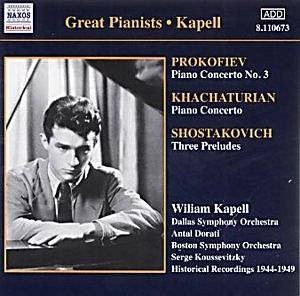
PROKOFIEV: Piano Concerto No. 3 in C, Op. 26; SHOSTAKOVICH: Preludes, Op. 34 (Nos. 24, 10, 5); KHACHATURIAN: Piano Concerto in D-flat**
William Kapell, piano; Dallas Symphony Orchestra/Antal Doráti (Prokofiev); Boston Symphony Orchestra/Serge Koussevitzky (Khachaturian)
Naxos Historical 8.110673 [64:20]—William Kapell died at thirty-one. The plane crash that killed him in 1953 robbed American pianism of something incalculable—not just promise, which is cheap enough, but achievement already realized at a level few reach in twice the time. Yet his name circulates oddly in our current culture of remembrance. Lipatti, dead at thirty-three, has become a secular saint. Kapell remains somehow specialist property, known to those who know.
This disc makes a compelling case for reconsidering that neglect. The Prokofiev Third—often dismissed as brilliant fluff, a kind of Soviet-era Mendelssohn confection—emerges here with its teeth bared. Kapell doesn’t just play the notes with the requisite digital facility (though God knows he does that). He inhabits the music’s violent mood swings, its lurches between sardonic brilliance and genuine lyricism, with an intensity that can make you forget to breathe. When the second theme of the opening movement arrives, he shapes it with such poetic withdrawal that the subsequent return to motoric energy feels genuinely shocking rather than merely structural.
Doráti, already forty-three in 1949 and fully formed as the incisive, slightly hard-edged director we remember from those Mercury recordings, matches him blow for blow. The Dallas Symphony sounds lean and hungry—there’s an athletic quality to the string playing in the variations that serves the music better than plushness would. Mark Obert-Thorn’s transfer favors upper frequencies rather aggressively; the piano emerges with startling presence, but the orchestral violins can turn shrill in tutti passages. It’s not an entirely comfortable sound. But for students of pianism—and Kapell’s pianism specifically—the trade-off seems justified.
The brief Shostakovich Preludes, recorded in RCA’s New York studio in 1944, show another side entirely. Here the textures are drier, more austere. Kapell penetrates the bitter poetry of the E-flat minor (No. 24) with remarkable maturity for a twenty-two-year-old. The voicing in the C-sharp minor (No. 10) reveals genuine polyphonic thinking, not just fingers sorting out the notes. These are miniatures, yes, but they’re played as if they mattered.
And then there’s the Khachaturian.
One approaches this with… trepidation. The Piano Concerto in D-flat enjoyed considerable vogue in the 1940s—Kapell championed it, though he later dropped it from his repertoire, which tells you something. The reading here, from April 1946 with Koussevitzky and the Bostonians, represents pianism of the first order applied to music of the third. Kapell’s virtuosity is genuinely astonishing: the octave passages emerge with diamantine clarity, the fingerwork in the "finale" approaches the superhuman. But the material itself—how does one say this diplomatically?—resists elevation.
I’ve compared this to a 1963 Turin broadcast with Sergio Perticaroli and the composer conducting. Perticaroli lacks Kapell’s demonic artistry, obviously. But something curious happens: played with less intensity, with a lighter touch, the music becomes… well, bearable. Almost charming, like a Russian Saint-Saëns. Khachaturian himself draws a frothy quality from the "finale" that Koussevitzky’s hard-hitting approach entirely misses. Kapell’s “imaginative” underlining of inner voices and countermelodies in the slow movement—neurotic is not too strong a word—seems determined to find profundity where none exists.
The problem, finally, is that Kapell’s larger-than-life interpretive approach, so revelatory in the Prokofiev where the material can support it, risks thrashing fragile goods. Khachaturian’s idiom, for all its surface glitter, doesn’t bear the weight of such scrutiny. The emperor has no clothes, and Kapell insists on describing the cut of the fabric.
But these are cavils. The Prokofiev alone justifies acquisition—it’s among the most electrifying performances of the work I know, revealing depths in music too often treated as merely brilliant. At Naxos price, with the Shostakovich as bonus, this belongs in any serious collection of historical piano recordings. Kapell was an artist of genuine importance, and his early death remains one of American music’s most grievous losses. Hear him.