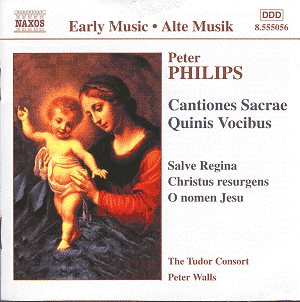
Peter Philips: Cantiones Sacrae (Motets for Five Voices)
The Tudor Consort/Peter Walls
Naxos Early Music Series 8.555056 [70:12]—Peter Philips remains one of those composers who ought to have secured a more prominent place in our consciousness—but hasn’t. Perhaps it’s the accident of geography that did him in: while Byrd stayed home and navigated the treacherous waters of Elizabethan religious politics, Philips decamped to the Spanish Netherlands in 1582 and spent the rest of his life there, serving as organist to the Archduke Albert. Out of sight, out of mind. Yet the music itself—when you actually hear it—tells a different story.
This Naxos disc presents a generous selection from Philips’s 1612 Cantiones Sacrae, motets designed for the liturgical year and common of the saints. Right away, the opening “Salve Regina” announces something distinctive. The Tudor Consort, a New Zealand ensemble under Peter Walls, catches the music’s peculiar quality: it’s English in its linear clarity and textural transparency, yet there’s an unmistakable Continental inflection in the harmonic language. Listen to how Philips darkens the palette at “ad te suspiramus“—those suspensions bite harder than Byrd would allow, the chromatic inflections more pungent than anything you’d find in Tallis.
The vocal blend here is exemplary. Not that glassy, over-blended sound that some early music groups cultivate—you can hear individual strands without the texture ever turning coarse or grainy. In “Christus resurgens,” where Philips builds his polyphonic edifice through successive points of imitation, the architecture remains audible. The sopranos (assuming that’s what they are; the booklet doesn’t specify the exact vocal configuration) maintain a bright but never shrill timbre, while the lower voices provide genuine foundation rather than mere support.
What strikes me most forcibly about these motets is their sheer length. Philips thinks in broad paragraphs—“O nomen Jesu” runs nearly twelve minutes, an expansiveness almost operatic in scope. He’ll take a single phrase from the text and worry it through multiple contrapuntal permutations before moving on. Some might find this prolix; I find it absorbing, particularly when the performers sustain the long line as convincingly as they do here. There’s a passage in “Ascendit Deus” where the texture thins to three voices before the full complement gradually reassembles—the effect, in this interpretation, is genuinely thrilling, a shaft of light breaking through.
The acoustic of the Chapel College in Island Bay serves the music well enough, though I’d have welcomed a touch more resonance. As it stands, the slightly dry ambience lets you hear everything—every entry, every suspension, every carefully prepared cadence—but sacrifices some of that numinous glow that sacred polyphony can generate in a more reverberant space. It’s a trade-off. Given the music’s contrapuntal density, clarity probably trumps atmosphere.
Walls shapes these performances with intelligence and a fine sense of proportion. He doesn’t overdo the “word painting” that the booklet notes make much of—and rightly so, because Philips’s text-setting, while certainly responsive to meaning, never descends into the pictorial obviousness of some Italian contemporaries. The madrigalisms are there if you listen for them, but they’re subsumed into the larger musical argument. In “Tibi laus, tibi gloria,” the ascending figures on “ascendit” feel inevitable rather than illustrative.
The singers’ Latin pronunciation is clean and idiomatic, though I caught a few vowels that wandered toward the Anglophone. No matter. The musicianship is secure throughout, intonation rock-solid even in passages of considerable chromatic complexity. And they’ve clearly internalized the rhetorical gestures—those subtle agogic swells, the gentle yielding at cadential points—that make this music breathe.
Does Philips deserve to stand alongside Byrd? On this evidence, absolutely. The comparison isn’t exact—Philips is more adventurous harmonically, less austere, perhaps less profound—but the craftsmanship is every bit as accomplished, the expressive range equally wide. These motets bridge the gap between Renaissance polyphony and early Baroque sensibility with remarkable assurance. They sound neither archaic nor avant-garde, but fully realized works that speak their own language.
This is important repertoire, expertly performed and decently recorded. Naxos continues its invaluable work of rescuing neglected corners of the early music landscape, and enthusiasts should be grateful. The Tudor Consort makes a strong case for music that deserves to be heard more often. I’ll be returning to this disc.