Chaliapin’s Boris: A Voice from Beyond
This isn’t just a historic release. It’s a séance.
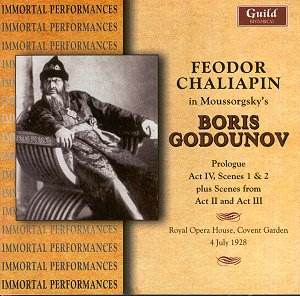
Guild Historical has done something extraordinary here—resurrecting a 1928 Covent Garden Boris Godunov with Feodor Chaliapin in the title role, singing in Russian while his Italian colleagues gamely proceed in their own tongue. The result shouldn’t work. By every rational measure, it’s a Tower of Babel, a polyglot mess. And yet Chaliapin’s Boris stands so monumentally apart from the proceedings that the linguistic chaos becomes almost irrelevant. This is less an ensemble opera than a one-man passion play with orchestral and choral accompaniment.
I’ve spent decades listening to Chaliapin recordings, studying the testimonies of those who heard him live, trying to understand what made critics of that era reach for superlatives they’d never used before or since. This restoration—lovingly assembled by Richard Caniell and Keith Hardwick from original transcription disc masters—gets us closer to the truth than anything I’ve encountered. Yes, the sound crackles and recedes. Yes, there are patches (notably the Pimen narrative, supplied from another Moscona performance) where the acoustic perspective shifts awkwardly. None of it matters.
What comes through is the psychological penetration. Chaliapin’s “Dostig ya vyshey vlasti” isn’t sung so much as inhabited—the voice still substantial in 1928, darker than in his 1914 recordings with Beecham, with that peculiar bronze timbre in the lower register that could suggest both authority and corruption. He shapes phrases with what sounds like spontaneous discovery, as if Boris’s guilt were revealing itself moment by moment. The famous clock scene—well, you can hear why Stanislavsky considered him a revolutionary actor. The voice thins to a thread, catches, breaks deliberately on certain syllables. Modern singers wouldn’t dare such things. We’ve been trained toward a more generalized excellence.
The death scene runs nearly fifteen minutes and demands to be heard complete. Chaliapin moves from rage to tenderness to delirium without ever losing the through-line of character. When he addresses Feodor, the tone shifts to something almost gentle—then that terrifying cry as madness returns. The final “Bog” emerges as barely a whisper, yet it carries absolute conviction. I’ve heard Christoff’s elemental power, Ghiaurov’s tragic nobility, even the young Kipnis. None of them approach this.
As for the rest? Vincenzo Bellezza conducts with competence but no particular insight—he keeps things moving, doesn’t get in anyone’s way. The Italian singers are… well, Italian singers of the period doing their best with Mussorgsky. Dino Borgioli brings an inappropriate Latin sweetness to the Pretender. Salvatore Baccaloni’s Varlaam sounds like it wandered in from Don Pasquale. The chorus, to their credit, manage something approaching Slavic heft, and the Covent Garden orchestra plays with more idiomatic understanding than you might expect.
But let’s be honest: nobody’s listening to this for ensemble values. We’re here for Chaliapin, and what Guild has preserved is nothing less than the blueprint for how this role should be conceived. Every Boris since has been measured against this standard, whether the singer knew it or not. The vocal acting, the way text and tone become inseparable, the courage to strip away conventional “beauty” in service of truth—it’s all here.
The restoration itself deserves praise. Caniell’s essay details the detective work involved, the careful matching of sources, the digital archaeology required to make 75-year-old transcription discs yield their secrets. Inevitable limitations remain—the orchestra sometimes sounds like it’s playing in an adjacent room, and there’s persistent surface noise. But the voice comes through with remarkable presence, and the dramatic arc never falters.
This belongs in every serious collection of vocal art. Not as a curiosity, not as a historical document to be respectfully acknowledged and shelved, but as a living testament to what operatic rendition can achieve when genius and role align perfectly. Chaliapin didn’t sing Boris. He was Boris. And thanks to Guild, we can still witness the haunting.