
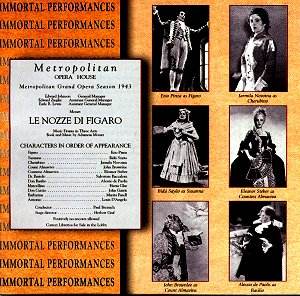
Mozart: Le nozze di Figaro**
Metropolitan Opera, 1943 (Paul Breisach)
Guild Historical 2203–5 [3 CDs]
Here’s a riddle. What do you get when you take Ezio Pinza, Bidú Sayão, Eleanor Steber, Jarmila Novotná, and Salvatore Baccaloni—singers who collectively represent nearly everything glorious about mid-century opera—and put them onstage at the Met during wartime? The answer, preserved on these Guild Historical discs, is very nearly heaven, though not without a few earthly impediments.
Paul Breisach wasn’t Bruno Walter. Let’s be clear about that from the start. Walter had conducted this production earlier in the 1942–43 season, and one assumes—hopes, really—that his performances had more breathing room, more tenderness in the great ensembles. Breisach occasionally hurries. The Act Four "finale" threatens to leave the timpanist scrambling (he catches up, bless him), and there are moments when the maestro seems more concerned with forward momentum than with allowing Mozart’s architecture to unfold naturally. But ensemble lapses are rare, and when they occur, they’re usually the result of someone singing from deep upstage or getting caught up in the dramatic urgency of the moment. Which is to say: this is theater, not a studio release sanitized of all human spontaneity.
The audience knew their Figaro. You can tell. They laugh at precisely the right moments—Cherubino behind the chair, the revelation of Figaro’s parentage in the Sextet, those magnificent slaps—and they do so without benefit of surtitles. Italian was still the international language of opera in 1943, at least for the Met’s subscription audience. What’s more irritating is their compulsion to applaud each principal’s first entrance, obliterating bars of Mozart in the process. Curiously, they withhold this dubious honor from John Brownlee’s Count. Critical discernment? Or simple exhaustion?
If so, they weren’t wrong. Brownlee—Glyndebourne pedigree notwithstanding—is the weak link here. His Count is wooden, terribly British, disappointingly dull until his Act Three aria, where he finally unbutttons vocally and remembers he’s supposed to be a Spanish nobleman consumed by jealousy and thwarted desire. One hears the Glyndebourne training: clean line, proper diction, all very respectable. But respectability is death to this role. The Count needs erotic danger, vocal swagger, the kind of tonal bite that makes you understand why Susanna and the Countess are both fascinated and repelled. Brownlee gives us a bank manager in period costume.
Pinza, by contrast, is everything a Figaro should be—and then some. That voice. Dark, burnished, capable of extraordinary dynamic range without ever forcing or losing its inherent beauty. When his ire is aroused, you feel the full weight of his dramatic power, yet he can spin out “Non più andrai” with such buoyancy that you understand why this man will always outwit his master. Twenty-two seasons at the Met, 878 performances of 52 roles—and yet there’s nothing routine about this reading. Every phrase feels considered, lived in. His native Italian helps, certainly, but it’s more than that. This is a complete characterization, and one senses (even without the visual element) his renowned histrionic ability animating every bar.
The women are simply glorious. All of them. Eleanor Steber was twenty-seven when this was broadcast—her radio debut in the role—and Bruno Walter’s faith in her is vindicated in every phrase. Yes, her tone is lighter than what we’ve come to expect from Countesses in the post-Schwarzkopf era. There’s nothing refulgent or creamy here, none of Te Kanawa’s shimmering opulence. Instead, Steber gives us a girlish Countess with a silvery, penetrating tone that cuts through the orchestral texture like moonlight. “Porgi amor” has real pathos without any hint of self-pity—a difficult balance to strike. This is a woman who still loves her husband despite everything, and Steber’s vocal purity makes that love heartbreakingly credible.
Sayão’s Susanna is the perfect foil: spunky, fuller-toned, alive to every dramatic nuance. In sixteen seasons at the Met she sang twelve roles—Rosina, Violetta (much admired), Adina, Gilda—and you can hear why. The voice has warmth and color throughout its range, the lower notes taking on a particular textural richness. Her “Deh vieni” is ravishing, inflected with such tender shading that you forget you’re listening to a broadcast from eighty years ago. And when she joins Steber for the Letter Duet… well. One could wish for nothing more on this mortal coil. The blend is that perfect, that ravishing.
Novotná’s Cherubino has real vocal heft—this isn’t some wispy soubrette playing at adolescence. Born in Prague in 1907, she’d already had a considerable European career (Adina with Schipa, Gilda with Lauri-Volpi, Butterfly with Tauber) before arriving at the Met in 1940. The voice has substance and color, with enough darkness in the lower register to suggest genuine ardor. You understand why the Countess is unsettled by this boy’s attentions.
Baccaloni’s Bartolo is pure buffo gold—vivid, personable, every word etched with character. One can see him while listening, which is the highest compliment one can pay a singing actor. The audience barely lets him finish his aria before erupting in applause, and for once, their enthusiasm seems entirely justified.
The sound is remarkably good for its provenance, though there are inevitable dips and patches of surface noise. Guild has done honest work here: where the original masters were unacceptable, they’ve inserted material from other broadcasts with the same cast, amounting to perhaps twenty minutes across the four acts. Purists may object, but the editorial choices seem judicious. The continuo is played on piano—regrettable but expected for the period—and the player occasionally struggles to keep things moving when applause interrupts the musical flow. One senses his frustration. The prompter is audible throughout, which seems unnecessary given this cast, but it adds to the documentary flavor of the performance.
