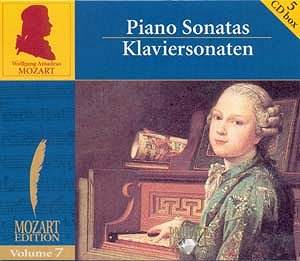
Mozart: The Complete Piano Sonatas
Klára Würtz, piano
Brilliant Classics (5 CDs)
The problem with Mozart’s piano sonatas—and it’s a real problem for performers—is that they offer nowhere to hide. Strip away the accompaniment, the orchestral color, the operatic drama, and you’re left with naked melodic lines that must sustain themselves through sheer rightness of inflection. Miss that inflection by a hair’s breadth and the whole edifice collapses into mere competence.
Klára Würtz misses it.
Not by much, mind you. She’s a thoroughly professional pianist with clean craft and sensible tempos. The early Munich sonatas (K. 279–284) emerge with proper classical proportions, the runs in the E-flat Sonata’s "finale" dispatched with ease. The A minor Sonata K. 310—that extraordinary outpouring of grief Mozart composed after his mother’s death—receives careful attention to its dramatic contrasts. But careful isn’t enough. Where Brendel finds an almost unbearable poignancy in the “"Andante" cantabile con espressione,” Würtz gives us merely a well-shaped slow movement. The notes are there. The music isn’t quite.
I kept waiting for those moments when a phrase suddenly blossoms into revelation—when the “"Andante" amoroso” of K. 281 becomes not just lovely but necessary, when the variations of K. 284 build to something more than technical display. They never came. Würtz plays as though Mozart’s galant surfaces were the whole story, missing the shadows and depths beneath. The famous “"Rondo" alla Turca” tinkles along pleasantly enough, but Uchida’s album reminds us that even this bon-bon has bite.
The recorded sound doesn’t help matters. Too much ambient wash from the Maria Minor church in Utrecht—the instrument (identified mysteriously as a “Steinberg,” presumably a typo for Steinway) seems to float in a hazy middle distance rather than speaking directly to the listener. The piano itself sounds oddly characterless, neither the bright clarity of a modern Steinway nor the transparent textures of a fortepiano. Just… there.
Some individual movements fare better than others. The “Rondeau en polonaise” from K. 284 has genuine charm, and Würtz handles the contrapuntal complexities of K. 576—Mozart’s last sonata, and one of his most sophisticated—with admirable clarity. But even here, the music-making remains curiously earthbound. These performances never take flight.
The real issue, I think, is one of rhetorical understanding. Mozart’s piano writing is essentially operatic—these melodies need to breathe and inflect like human voices, with all their subtle shifts of emphasis and meaning. Würtz approaches them more as abstract patterns to be realized accurately. She observes the letter of Mozart’s markings without fully inhabiting their spirit. The C minor Sonata K. 457 (composed as a companion piece to the C minor Fantasy, not included here) should sear; instead it merely announces itself as serious music and moves on.
At budget price, this set serves adequately as a reference library of the sonatas. The playing is never less than competent, sometimes rising to quite good. But Mozart deserves more than competence. These works, as Robert Gutman rightly observed, “appear impoverished in character” when sensitivity is lacking—and that’s precisely what happens here. The music becomes, in Würtz’s hands, a series of pleasant sounds rather than a sequence of human utterances.
For discovering these pieces? Fine. For living with them? Look elsewhere. Brendel’s earlier Philips cycle captures both the classical poise and the emotional undertow; Uchida’s later Decca recordings find an even more intimate poetry. Both pianists understand that Mozart’s apparent simplicity is an illusion—that these sonatas demand not just clean fingers but deep listening, not just technical accuracy but imaginative transformation.
Würtz offers the notes. Mozart requires more.
Kirk McElhearn’s review for MusicWeb International (2002) reaches similar conclusions, though perhaps more charitably expressed.