
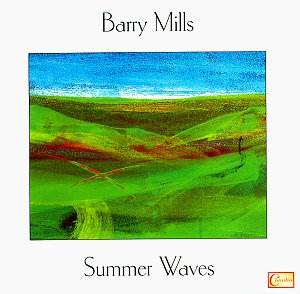
A Postman’s Pastoral: Barry Mills’s Unassuming Mastery
Here’s something you don’t encounter every day—a Brighton postal worker who composes chamber music of genuine refinement in the afternoons, having studied with Colin Matthews. Barry Mills, born in Plymouth in 1949, isn’t going to trouble the Proms programmers anytime soon. But this Claudio disc, recorded in the generous acoustics of All Saints, Eastbourne over three years in the mid-1990s, reveals a composer of authentic sensibility and no small technical resource.
The pictorialism is worn lightly. Mills doesn’t belabor his nature subjects—the autumnal descent in Saxophone Sketches, the spectral wind effects that animate the Saxophone Quartet. He’s after something more elusive than mere tone painting. The alto saxophone work (Tony Sions plays with admirable focus) deploys chilly overblowing to evoke winter’s approach, but it’s the structural logic that impresses, not the programmatic literalism. “Morning Song,” the opening movement of the quartet, shows Mills at his most characteristic: restrained, angular, essentially tonal but never complacent about it. The soprano saxophone in “Night Winds“—ghostly, yes, but also formally purposeful.
Philip Edwards tackles The Wind and the Trees with the kind of commitment the piece demands. The pitch-bending and flutter-tonguing could easily descend into gimmickry. They don’t. Mills knows what he’s doing with instrumental color, exploiting the B-flat clarinet’s timbral resources without fetishizing extended techniques for their own sake. The subsequent Duo for Flute and Clarinet explores—that word again, but what else will do?—elliptical tonal contrasts with real subtlety.
The Guitar Quartet may be the disc’s strongest offering. Mills’s avowed appreciation of nature (in its widest sense, we’re told) finds its ideal medium in the instrument’s plucked sonorities. “Moving with the Wind” captivates through sheer textural invention, while “In Deep Night” thrums with a kind of restless nocturnal energy. The English Guitar Quartet plays with evident sympathy for Mills’s aesthetic—impressionistic without being derivative, reflective without lapsing into New Age vapidity.
What strikes me most forcefully across these seventy-odd minutes is Mills’s narrative gift. The trios for flute, viola, and guitar, and flute, viola, and harp prove real compositional thinking—not just attractive sounds strung together. His viola writing deserves particular mention. He pursues extremes of register (Peter Sulski handles the demands capably) but always for valid musical reasons. No comfortable generic gestures here, no padding of the sort that afflicts so much contemporary chamber music.
The performances throughout are dedicated—more than merely dedicated, in fact. Charlotte Munro’s flute tone remains focused even in the most exposed passages, and Paul Gregory navigates Mills’s guitar writing with technical assurance and musical intelligence. Hugh Webb’s contributions to the Harp Sketches and the harp trio reveal an instrument too often consigned to glissando clichés; Mills writes idiomatically without condescension.
Disc quality is perfectly adequate, though the church acoustic occasionally blurs rapid passagework. A minor quibble. This is music of modest ambition but genuine accomplishment—the work of a composer who knows his craft and has something to say within carefully chosen limits. Mills won’t revolutionize contemporary music, but he enriches it. That’s worth celebrating.
Recommended.
