Mozart Symphonies with a Gentle Touch
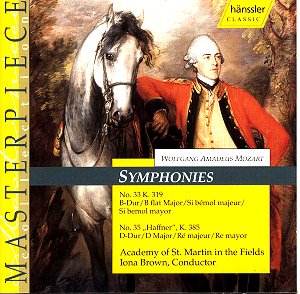
Iona Brown’s approach to these two Mozart symphonies—the B flat K319 and the Haffner—belongs to an earlier aesthetic, one that now feels almost quaint in our period of high-velocity, historically informed reading. Not that there’s anything wrong with that, necessarily. But we’ve moved on.
The Academy of St Martin-in-the-Fields under Brown plays with the kind of cushioned warmth that Marriner established as the ensemble’s house style decades ago. Tempos are comfortable, almost leisurely in the outer movements of both works. The Haffner‘s opening lacks the theatrical punch, the almost aggressive brilliance that this D major fanfare demands—it’s Mozart at his most public, after all, originally conceived for the ennoblement celebrations of Salzburg’s Haffner family. Here it emerges sounding merely pleasant, the dynamic contrasts smoothed over, the sforzandi polite rather than startling.
Brown secures luminous string tone throughout. The violins have that burnished glow, vibrato applied with taste if not exactly with period-appropriate restraint. In the slow movements—the "Andante" moderato of K319 and the "Andante" of the Haffner—this pays dividends. The Academy strings shape phrases with genuine sensitivity, and there’s real listening happening within the section. But even here, one misses a certain flexibility, a willingness to take risks with rubato or color.
The minuets pose particular problems. Mozart’s minuets aren’t Viennese waltzes—they have weight, sometimes even a hint of the peasant dance floor. Brown’s readings float rather than stamp. The Haffner minuet should have more heft in its stride; instead we get something closer to salon music, elegant but undercharacterized. The trio sections fare better, particularly in K319, where the wind solos emerge with personality.
What’s most troubling is the lack of structural awareness in the "finale" movements. The Haffner‘s concluding "Presto" should build inexorably, gathering momentum like a runaway coach. Brown keeps everything under tight control—admirably precise ensemble, yes, but where’s the exhilaration? The development sections pass without much sense of harmonic adventure or dramatic stakes. It’s all rather… safe.
The 1997 Henry Wood Hall release captures the ensemble with warmth and reasonable detail, though the perspective is somewhat distant. You won’t hear much in the way of individual characterization from the wind players, despite competent work throughout.
This disc represents perfectly acceptable Mozart playing from another era, when smoothness and beauty of tone were paramount virtues. But after Harnoncourt, after Norrington, after Jacobs and Gardiner and Brüggen—after we’ve learned how much rhythmic vitality and timbral variety these scores contain—this kind of performance feels like looking at Mozart through gauze. Pleasant enough, but missing too much of the composer’s wit, energy, and occasional asperity. The Hänssler budget price makes it marginally more attractive, but there are simply too many more compelling versions available now.