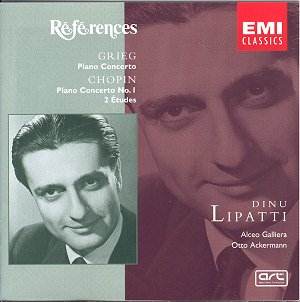
Ghosts and Memories: Lipatti’s Chopin and the Perils of Nostalgia
There’s always something unsettling about returning to recordings that shaped one’s early musical consciousness. You risk discovering that the memory has been kinder than the reality—or worse, that you’ve spent decades carrying around an idealized version that never quite existed.
This Lipatti disc presents both problems at once, complicated further by one of the more embarrassing episodes in the history of recorded music criticism. The Chopin Concerto No. 1 in E minor that appears here is the genuine article, recorded in Zurich in February 1950, not the rendition by Halina Czerny-Stefańska that EMI mistakenly issued in 1971 to considerable critical acclaim. (One wonders how many other “legendary” performances might survive similar scrutiny.) The sound suggests an amateur tape made off Swiss radio—woolly, distant, with the orchestra emerging from what sounds like several layers of gauze. Otto Ackermann’s opening tutti is so perfunctory, so utterly devoid of character, that one marvels Lipatti bothered to sit through it.
But then the piano enters.
What strikes immediately is the complete absence of rhetoric. Lipatti doesn’t play at you or even particularly for you. He simply inhabits this music with such naturalness that the distinction between interpretation and composition seems to dissolve. Listen to how he shapes the main theme of the first movement—the slight hesitation before the downward cascade, the way certain inner voices suddenly emerge without any obvious dynamic emphasis. It’s as though he’s discovered a text beneath the text. The Romanze becomes genuinely operatic, not in the sense of exaggerated gesture but in its long-breathed phrasing, the way each melodic strand spins out with inevitable logic. Even the "finale", which can sound merely brilliant in lesser hands, takes on unexpected depths. Those octave passages in the coda—most pianists treat them as virtuoso display, but Lipatti finds genuine pathos there.
The two études that fill out the disc (the “Wrong Note” and “Black Key” from the respective opus numbers) come from the same broadcast. Better sound, actually. The E-flat minor étude has that particular combination of technical security and expressive freedom that marks all of Lipatti’s Chopin—nothing is merely executed, everything is felt. The G-flat étude sparkles without ever becoming merely decorative.
The Grieg coupling from 1947 presents different challenges. The Abbey Road sound is better—EMI’s engineers knew their business—but Alceo Galliera’s conducting proves problematic. He takes a curiously cavalier approach to the orchestral tutti, rushing through the second subject of the first movement with inappropriate haste and concluding it with an enormous rallentando that has Lipatti entering at a tempo that clearly contradicts what preceded it. The slow movement’s introduction suffers similarly: too fast, with the wrong kind of rubato, all surface glitter where Grieg wanted something approaching mystery.
Yet Lipatti himself remains extraordinary. His touch in the quiet passages achieves that peculiar transparency—you hear through the sound to the harmonic progression beneath. But this is also, I must confess, a more impetuous performance than memory had preserved. The first movement cadenza has genuine impetuosity, almost recklessness. This is a young man’s Grieg, dashing and brilliant, not the Olympian serenity I’d somehow convinced myself I remembered from those old 78s.
Memory plays such tricks. Over the years, as my own conception of the Grieg Concerto evolved, I must have unconsciously retrofitted those changes onto my memory of Lipatti’s performance. What I thought I remembered—calm, measured, classical in its proportions—turns out to have been largely my own invention. The actual performance, while radiant, is rather different.
The CD transfer doesn’t help matters. It seems to exaggerate both the delicacy and the harshness of the original recording—quieter passages sound lovely, but the big climaxes turn clattery and distorted. One suspects the 78s, played on appropriate equipment, might have worn their years better.
Solomon’s Grieg holds up more convincingly, I think, and Curzon’s has similar virtues. If you want the concerto in modern sound with real interpretive distinction, Lilya Zilberstein with Neeme Järvi offers fresh simplicity without any loss of poetry. That release comes in Järvi’s six-disc Grieg survey on DG—everything the composer wrote for orchestra, all of it admirable.
But the Chopin remains essential, wretched sound notwithstanding. This is playing that reminds you why Lipatti’s early death felt like such a catastrophe. Here was someone who understood that Chopin’s rhetoric, however elaborate, always serves expression—never the reverse. The poetry isn’t applied from outside; it emerges from within the musical structure itself.
EMI might have done better to couple this performance with the Czerny-Stefańska they originally mistook for it. Now that would have made for an interesting comparison—two performances, one praised to the skies when critics thought it was Lipatti, the other consigned to oblivion once the mistake was discovered. What does that tell us about critical judgment? About the power of reputation? About whether we actually hear what’s there or only what we expect to hear?
Perhaps it’s better not to think too hard about such things. Better simply to listen, with faith tempered by appropriate skepticism, and be grateful that at least some of Lipatti’s Chopin survived in any form at all.