
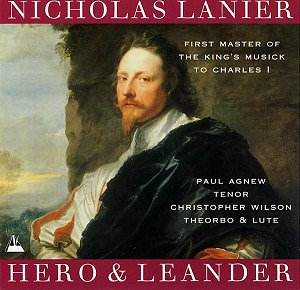
A Master of the King’s Musick, Rediscovered
Nicholas Lanier remains one of those fascinating historical figures who lived so many lives—painter, lutenist, singer, art collector, diplomat—that his music sometimes gets lost in the biographical shuffle. Which is a pity. Because when you actually sit down with these songs, particularly in a rendition as knowing and technically assured as Paul Agnew’s, you realize that Lanier’s musical sophistication was no mere courtly accomplishment but something genuinely substantial.
The biographical details do matter here, though. Lanier spent considerable time in Italy, spoke fluent Italian, moved in circles where Monteverdi’s innovations were immediately absorbed and debated. His appointment as the first Master of the King’s Musick under Charles I wasn’t ceremonial fluff—he shaped the musical life of the Caroline court with real aesthetic purpose. You can hear all of that cosmopolitan awareness in these twelve songs, which range from straightforward English lute-song tradition to full-throated Italianate declamation.
The centerpiece is “Heros complaint to Leander,” a fifteen-minute scena that Jonathan Woolf’s notes rightly identify as a reconstruction incorporating symphonies by Henry Lawes. It’s an ambitious thing, this piece—proto-operatic in its dramatic scope, with recitative-like passages that suddenly flower into intensely lyrical moments. Agnew handles the shifting affects with remarkable subtlety: the soft-grained intimacy of “Weep, weep mine eyes” gives way to that thrilling clarion cry “Heav’ns lend your aid and arm yourselves in thunder.” His trumpet tone there is genuinely exciting, no careful early-music politeness.
Christopher Wilson’s accompaniment throughout deserves equal billing. On theorbo and lute, he provides far more than discreet support—there’s real dialogue happening, particularly in the Italian songs where the instrumental lines interweave with the vocal line rather than simply underpinning it. Listen to “Qual musico gentil” and you’ll hear what I mean: those melismatic runs Agnew negotiates so effortlessly are answered and anticipated by Wilson’s plucked commentary.
The Italian settings reveal Lanier at his most adventurous. “Amorosa pargoletta” finds Agnew rolling his r’s with what sounds like genuine relish—not overdone, but enough to signal the stylistic shift. These aren’t English songs with Italian texts; they’re genuine attempts to write in an Italian manner, complete with the kinds of vocal leaps and ornamental flourishes that would have sounded decidedly foreign to English ears circa 1630.
But it’s the Thomas Carew settings that really stop you cold. “No more shall meads be deck’d with flowers” unfolds over seven minutes of ground bass variations that do indeed anticipate Purcell—the comparison isn’t hyperbolic. The way Lanier builds emotional intensity through harmonic variation while maintaining the ground’s inexorable tread… well, it’s compositional craft of a high order. Agnew paces it beautifully, allowing the grief to accumulate without pushing, trusting the structure to do its work.
His voice itself—a light, flexible tenor with outstanding clarity in the upper register—suits this repertoire ideally. There’s none of that hooty, overly vibrato-laden sound that can make early English song seem precious. Instead: clean lines, intelligent text-setting, and a real understanding of how these songs would have functioned in their original context. When he softens his tone for “Like hermit poor” or hardens it for the more declamatory passages, it never feels calculated. Just responsive.
The album, made at St. Andrew’s Church in Toddington, captures both voice and instruments with admirable clarity. Close enough to hear the physical details—fingers on strings, breath between phrases—but with sufficient acoustic around the sound to give it warmth. The balance between Agnew and Wilson is exemplary throughout.
If there’s a quibble, it’s that not every song here rises to the level of the Carew settings or “Heros complaint.” A few of the shorter pieces, charming as they are, don’t quite justify their inclusion beyond providing stylistic variety. But that’s a minor point in a recital that otherwise makes a genuinely persuasive case for Lanier’s importance.
This isn’t repertoire that gets programmed much anymore—too specialized for general recitals, perhaps too well-crafted to seem authentically “raw” to early music purists looking for rough-hewn authenticity. But performances this accomplished remind you what we’re missing. Lanier deserves better than historical footnote status, and Agnew and Wilson have given him advocacy of real distinction.
