Froberger’s Italian Manner—Mostly
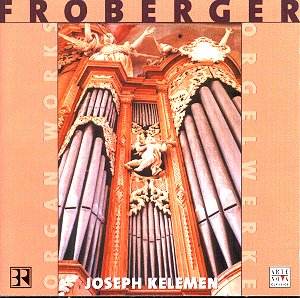
Johann Jacob Froberger remains one of those composers whose reputation has never quite caught up with his historical importance. Everyone knows he mattered—the bridge from Frescobaldi to Bach, the cosmopolitan keyboard master who carried Italian style northward—but how many of us actually listen to him with any regularity? This Arte Nova disc, part of their admirable budget series, offers Joseph Kelemen playing a dozen works on a restored Baumeister organ in Bavaria. The project has real scholarly merit. The execution is… well, more complicated.
Kelemen’s stated aim is to present “the Italian Froberger,” focusing on pieces influenced by those crucial Roman years with Frescobaldi. Fair enough. The toccatas, capriccios, and ricercares here do show that Italianate flair—the rhetorical gestures, the sudden harmonic shifts, the improvisatory freedom within strict contrapuntal frameworks. But as Kelemen himself admits in the notes, these works also reveal South German characteristics. That hybrid quality is precisely what makes Froberger fascinating, and it’s also what makes him devilishly difficult to bring off.
The Baumeister organ itself deserves attention. Built between 1734 and 1737, sealed away when the church changed hands in 1802, then silent for nearly two centuries until Steinmeyer restored it in 1988–90—this is the stuff of organophile fantasy. The instrument has no reed stops, which is limiting, but the plenum possesses that luminous, bright-edged quality characteristic of South German work. Mean-tone temperament favors C, F, and G major, giving those keys unusual clarity and sweetness. When Kelemen exploits this in the C Major Toccata (FbWV 109) and the G Major works, the results are genuinely luminous—that particular shimmer you get from well-tuned thirds in mean-tone is unmistakable.
Kelemen’s interpretive choices often work against the music’s architectural logic. His registration changes in the toccatas are restless, even fussy—he seems to treat every new section as an excuse to pull different stops, fragmenting what should feel like unified structures. The Toccata in A Minor (FbWV 112) suffers especially: Froberger’s careful balance between improvisatory freedom and formal coherence gets lost when the timbral landscape shifts every eight bars. And those trills! Kelemen adds ornaments with abandon, particularly at cadences where he piles on trills until the final chord sounds less like an arrival than a nervous tic. The effect is mannered, fussy—the opposite of the Italianate sprezzatura he’s presumably after.
The capriccios fare somewhat better. These are lighter, more dance-like pieces, and Kelemen’s articulation brings out their rhythmic vitality. Still, I wish he’d find more consistency within each piece. The tempo relationships between sections feel arbitrary—now brisk, now leisurely, without any audible logic connecting the choices. The G Major Capriccio (FbWV 507) lurches through its subject entries like a coach on bad roads.
Where Kelemen truly succeeds is in the more strictly contrapuntal works. The two ricercares (D Minor FbWV 407a and G Minor FbWV 405) benefit from his clear, well-articulated playing. Here, finally, the registration serves the music rather than decorating it. You can hear the individual voices emerging and recombining, the stretto passages building tension without rushing. The Fantasia sopra UT RE MI FA SOL LA—the so-called Hexachord Fantasia, Froberger’s only work published in his lifetime—receives a genuinely distinguished reading. Kelemen understands that this piece is essentially a learned display, a set of variations on the hexachord subject that proves contrapuntal mastery while maintaining musical interest. He doesn’t try to make it more “expressive” than it needs to be. Just clean, intelligent, lucid playing.
The Toccata da Sonarsi alla Levatione in G Minor stands as the disc’s high point. Written for the Elevation of the Host, this is liturgical music of real gravity and inwardness. Kelemen adopts a slower tempo, uses registration sparingly, and lets the harmonies breathe. For once, his instinct for stasis rather than motion serves the music perfectly. The piece unfolds with genuine mystery—those suspended dissonances, the way the voices seem to hover rather than progress, the sense of time stopping. This is what the whole disc should have sounded like: thoughtful, shaped, responsive to the music’s particular character.
The recorded sound is outstanding—clear, spacious, with enough church acoustic to provide warmth without blurring detail. The booklet includes useful information about Froberger’s life, the organ’s specifications and history, and Kelemen’s registrations. There’s a small error in the notes about publication history (Kelemen seems confused about which works appeared when), but nothing that undermines the disc’s value.
So where does this leave us? If you’re curious about Froberger and operating on a budget, this disc offers a reasonable introduction. The Baumeister organ is worth hearing, and several performances—particularly the Hexachord Fantasia and the Elevation Toccata—are genuinely fine. But Kelemen’s interpretive inconsistencies and his tendency to over-register the toccatas prevent this from being a first recommendation. For that, I’d still point listeners toward the more integrated, stylistically confident recordings by Glen Wilson or Bob van Asperen. Still, at budget price, there’s enough here to reward the adventurous. Just be prepared for bumps along the way.