Froberger’s Intimate World: Dart’s Clavichord Testament
The clavichord was the secret instrument of the baroque—too quiet for the concert hall, too personal for display. It lived in bedrooms and studies, where Bach worked out fugues late at night and C.P.E. Bach cultivated his empfindsamer Stil. When you strike its strings through those brass tangents, you feel the vibration in your fingertips; there’s an almost tactile intimacy, a physical connection to sound that the harpsichord’s jack mechanism can never provide.
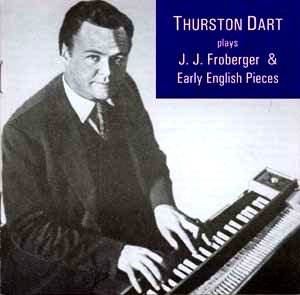
Thurston Dart understood this. His 1961 recording of Froberger—rescued from oblivion by J. Martin Stafford’s Ismeron label—captures something increasingly rare: a scholar-performer who trusted the music to speak without modernist overlay or authenticist dogma. (The recording date is actually 1961, not 1954 as the original notes suggest—though the sonic character certainly evokes the earlier decade.)
Froberger remains peculiarly undervalued. Born in Stuttgart, trained by Frescobaldi in Rome, he served as court organist in Vienna and traveled obsessively—to Paris, to Brussels, possibly to London. His keyboard suites synthesized Italian contrapuntal rigor with French rhetorical gesture, creating a uniquely German hybrid that Bach studied closely. The man wrote tombeau pieces before d’Anglebert made them fashionable, structured dance suites before they became standard issue.
The Suite No. X in A minor opens this recital, and immediately you hear Dart’s interpretive intelligence. The allemande unfolds with that characteristic clavichord singing tone—what the Germans called Bebung, that finger-vibrato possible only on this instrument. Dart doesn’t sentimentalize, but he allows phrases to breathe. The courante has genuine rhythmic snap; the sarabande achieves that paradoxical combination of grave nobility and improvisatory freedom that defines Froberger’s best work.
Those two lamentations—for Ferdinand IV (died 1654, age thirteen) and Ferdinand III (died 1657)—reveal Froberger’s expressive range. These aren’t abstract exercises but genuine Trauermusik, filled with rhetorical gestures: sighing appoggiaturas, chromatic descents, sudden harmonic jolts. The “Lamentation faite sur la mort très douloureuse de Sa Majesté Impériale Ferdinand le troisième” contains that famous programmatic conclusion where Froberger notates the emperor’s soul ascending to heaven—rising scales that dissolve into silence. Dart resists the temptation to over-interpret, letting the music’s inherent pathos speak.
The Ricercar No. VI in C-sharp minor—an unusual key for the period—proves Froberger’s contrapuntal mastery. Three voices weave through chromatic harmonies with a logic that anticipates Bach’s Well-Tempered Clavier. Dart’s articulation clarifies each subject entry without pedantic emphasis. You simply hear the architecture.
But it’s the Fantasia No. II that reveals why this repertoire matters. Opening with a slow fugal exposition in the Phrygian mode (that archaic scale with its characteristic semitone descent), it shifts between strict counterpoint and improvisatory flourishes. The piece feels spontaneous—as if Froberger were thinking aloud at the keyboard—yet maintains formal coherence. Dart captures this duality perfectly, maintaining structural clarity while allowing moments of expressive freedom.
The inclusion of five “Early English Pieces“—four anonymous works plus a Sarabanda from William Croft’s Suite No. 4 in C minor—seems initially odd. These are slighter pieces: “La Bounette,” “La Doune Cella,” “La Shy Myze,” “An Allemande fitt for the Manicord.” (Those titles suggest French influence on English keyboard practice, though the musical language remains stubbornly insular.) They provide relief from Froberger’s intensity, and the Croft Sarabanda makes an effective conclusion—its melancholy melody hanging in the air like smoke.
The clavichord itself—the notes don’t specify which instrument Dart used, though it’s likely a German-style model—sounds remarkably well-captured for early 1960s technology. Yes, there’s tape hiss, and the dynamic range is compressed by modern standards. But the essential character comes through: that silvery, slightly nasal tone, the subtle dynamic gradations, the sense of music-making at arm’s length rather than across a concert hall.
Stafford’s remastering deserves praise. He hasn’t tried to artificially enhance or “improve” the original tapes, just cleaned them up and presented them honestly. The result sounds like what it is: a sixty-year-old recording of an instrument that was already anachronistic in 1961.
Should you hear this? If you know Froberger only through harpsichord recordings—and most of us do—this disc offers revelatory insights into how this music might have actually sounded in domestic interpretation. The clavichord’s intimacy suits Froberger’s introspective character; his most personal utterances need this quiet voice. Dart’s scholarship wears lightly, his mastery serving musical ends rather than calling attention to itself.
The disc won’t convert clavichord skeptics. The instrument’s limitations are real: limited volume, quick decay, a tonal palette some find monotonous. But for those willing to meet Froberger on his own terms, in the instrument he likely knew best, this album remains essential. It’s a glimpse into a lost world of private music-making, when virtuosity meant something other than public display.
An indispensable document, lovingly preserved.