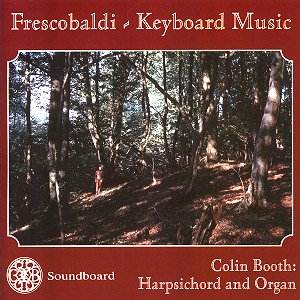
Frescobaldi: Keyboard Music
Colin Booth, harpsichord and organ
Soundboard SBCD 201 [76:19]
Colin Booth makes harpsichords. He also plays them—and organs too, when the spirit moves him. This matters more than you might think when approaching a disc of Frescobaldi’s keyboard music, because Booth understands these instruments from the inside out, knows their secrets and limitations, their sweet spots and their lies.
The program here draws from Frescobaldi’s three main keyboard genres: toccatas, variations, and fugal pieces. Booth divides the labor between a copy of an Italian harpsichord (his own work, naturally) and a modest two-stop organ. The choice of that organ—recorded in Easton Village Hall rather than some reverberant church—speaks volumes about Booth’s intentions. He wants us to hear the music, not the acoustic. No Gothic thunder, no wash of overtones obscuring the counterpoint. Just Frescobaldi, stripped down to essentials.
It’s an austere approach. Some will miss the grandeur, the sense of liturgical weight that a larger organ brings to this repertoire. But there’s real gain in clarity. Listen to Ricercar 3—the fugal lines emerge with unusual transparency, each voice distinct yet interwoven. Booth takes it slowly, perhaps too slowly for some tastes; there are moments when the forward motion seems to stall. Yet the reading casts a spell. The intimacy of the setting forces you to attend to every detail, every suspension and resolution.
The harpsichord pieces show off both Booth’s instrument and his mastery to better advantage. That opening section of Toccata 7—all those runs and embellishments cascading across the keyboard—could easily turn into mere display. Instead, Booth maintains the improvisatory character while keeping the structural lines audible. His touch varies from feather-light to surprisingly forceful, and the instrument responds with a tonal palette richer than you’d expect from a single-manual Italian.
The Partite sopra l’Aria della Romanesca runs nearly fifteen minutes, the longest work here, and it’s where Booth’s understanding of variation technique really pays dividends. Frescobaldi explores an astonishing range of affects across these partite—dance rhythms, chromatic harmonies, virtuoso passage-work, moments of near-stasis. Booth navigates all of it with assurance, adjusting his articulation and dynamic inflection (yes, on a harpsichord) to suit each variation’s character. He understands that these aren’t just technical exercises but explorations of emotional terrain.
The Capriccio sopra La, Sol, Fa, Mi, Re, Ut shows Frescobaldi at his most inventive, building an entire piece from that descending hexachord. Booth plays it on harpsichord, emphasizing the work’s intellectual games without making them feel dry or academic. There’s genuine wit here, and he finds it.
If I have reservations, they concern the organ performances. That small instrument, for all its advantages in clarity, lacks tonal variety. After a while, those two stops begin to feel limiting. The Toccata 11 works beautifully—it’s slow, contemplative music that suits the organ’s restraint. But in more extroverted pieces, you sense what’s missing. Still, Booth clearly made this choice deliberately, and there’s integrity in his consistency.
The recorded sound is superb—close enough to capture the instruments’ timbral nuances, distant enough to avoid mechanical noise. The programming alternates intelligently between instruments and genres, maintaining interest across seventy-six minutes.
This isn’t the only Frescobaldi you’ll need. But it’s a valuable addition to the discography, offering perspectives you won’t find elsewhere. Booth plays with scholarship and sensitivity, and his homemade harpsichord proves a genuinely radiant instrument. Recommended, especially to those willing to hear this music in a new light.