
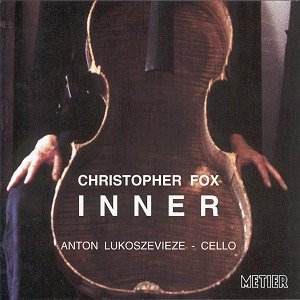
# Christopher Fox: Solo Cello Works
## Anton Lukoszevieze, cello
### Metier MSV CD92059 [72:42]
When a composer gets tagged as both “complex” and “minimal” by different observers, you know something interesting—or at least something genuinely difficult to pin down—is happening. Christopher Fox, born in 1955, occupies a peculiar corner of the new music world. This disc, devoted entirely to works for solo cello (with one electronic assist), makes a strong case that the contradictory labels actually fit.
The centerpiece here is inner, a forty-five-minute exploration that tests everyone’s patience—listener, performer, and probably the composer’s own nerve. Fox describes it as an investigation of the performer-audience relationship, structured in thirty related sections he calls “family trees.” The booklet urges you to read the notes first. Good advice. Without some conceptual scaffolding, inner can feel like an endurance test, a slow-motion inventory of what a cello can do when you stop thinking about melody, harmony, or anything resembling conventional musical discourse.
But here’s the thing: concentration brings rewards. Real ones. The piece does have architecture—not the kind you can whistle, but a genuine sense of structure that accumulates meaning as it unfolds. Anton Lukoszevieze sustains an extraordinary focus throughout, his bow control so finely calibrated that you hear the grain of individual strokes, the precise weight behind each attack. There’s a ritualistic quality to the repetitions, a kind of patient insistence that eventually wears down skepticism.
The three Generic Compositions (#3, #4, and #5, composed between 1991 and 2001) are shorter, more approachable investigations of string craft. Written for any four-stringed instrument, they explore plucking, bowing, and sliding respectively. The constraints sound academic on paper—and yes, there’s plenty of theory behind them—but Lukoszevieze makes them sound surprisingly… well, not exactly lyrical, but at least committed to sound itself rather than to demonstration. The plucked version has an almost folk-like directness, though Fox would probably bristle at that description.
Straight Lines in broken times³ (1994) ventures into microtonal territory, retuning the cello to explore three-quarter-tone scales and the quarter-tone modulations they permit. Fox denies any gamelan influence—he says so explicitly in the booklet interview—but there’s definitely something non-Western in the resulting sonorities, a sliding, unfixed quality to the pitch relationships that refuses equal temperament’s tidiness. Lukoszevieze navigates these treacherous intonation demands with remarkable assurance, though I suspect even he might acknowledge that absolute precision in this context becomes somewhat metaphysical.
The real challenge on this disc is “chant suspendu” (1998), originally for cello and piano, here presented with the piano part reduced to a computer-generated “particle” that functions as a continuous drone. Recorded in a single take—an astonishing feat given the density of the writing—the rendition has a teeming, claustrophobic intensity. The cello part swarms over that electronic hum like insects over still water. It’s the least immediately gratifying work here, the one that most resolutely refuses to meet you halfway.
Which brings us to the essential question: what is Fox after? The interview with Richard Ayres provides some clues, though Fox himself seems more interested in process than in articulating aesthetic goals. There’s a kind of scientific curiosity at work, a desire to map what’s possible within carefully defined constraints. The repetitions that mark all these pieces aren’t minimalist in the Reich-Glass sense—there’s no pulse-driven accumulation, no gradual transformation of simple materials. Instead, Fox uses repetition structurally, as a way of binding together extended techniques that might otherwise fragment into mere catalog of effects.
Lukoszevieze proves an ideal advocate. His technical command is formidable—the harmonics in inner bloom with crystalline clarity, the sul ponticello passages maintain their ghostly focus even at the softest dynamics. More importantly, he seems to believe in this music, to hear it as something beyond an interesting compositional problem. The recorded sound, captured at York’s Early Music Centre, is outstanding: close enough to reveal every bow hair’s contact with the string, but with sufficient ambient space to prevent claustrophobia.
Metier deserves credit for supporting Fox’s work with this second release. The label promises more collaborations with Lukoszevieze and his ensemble Apartment House, which bodes well. The packaging is exemplary—Fox’s own program notes are models of clarity, avoiding both condescension and opacity.
Will this music find a wide audience? Almost certainly not. Should it? That’s a harder question. Fox isn’t interested in seduction, in making things easy or immediately gratifying. His music demands active, sustained attention, a willingness to suspend conventional expectations about what solo string writing should accomplish. Some listeners will find that liberating. Others will find it arid, more concerned with system than with sound.
I fall somewhere in between, admiring the craft and the commitment while remaining uncertain about the ultimate rewards. inner, in particular, strikes me as a fascinating experiment that doesn’t quite transcend its experimental origins. But experiments matter. They push at boundaries, test assumptions, create space for possibilities we haven’t yet imagined. On those terms, this disc succeeds—not as easy listening, not as comforting confirmation of what we already know, but as a genuine exploration of what remains possible for a single cellist armed with curiosity, technique, and patience.
Whether that’s enough depends entirely on what you bring to the encounter.
