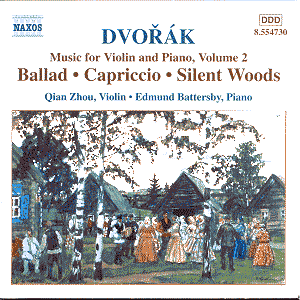
Dvořák: Music for Violin and Piano, Volume 2
Qian Zhou, violin; Edmund Battersby, piano
Naxos 8.554730 [54:58]
This second installment from Zhou and Battersby presents a curious grab-bag—salon favorites jostling against obscurities, Kreisler transcriptions rubbing shoulders with works that barely escaped the composer’s desk drawer. The programming makes a kind of sense, I suppose, if you’re determined to be complete. But completeness and coherence aren’t always on speaking terms.
Zhou possesses a quality I’ve noticed increasingly among younger players: a studied cultivation of timbral variety that can border on mannerism. Her “veiled tone“—as the annotation has it—works beautifully in the D minor Ballad, where the music wants that kind of inward, almost confessional quality. The instrument seems to retreat into shadow. Battersby matches her instinct here with genuinely subtle pedaling in the left hand, creating a gauzy harmonic halo that never goes muddy.
The Slavonic Dances, in their Kreisler garb, reveal both the strengths and limitations of this partnership. The G minor emerges with proper weight—these are, after all, stylized folk dances with real grit beneath the charm. But the G major concludes with pizzicatos so literal, so utterly without wit, that you wonder if they’d ever heard Heifetz toss off those final notes with that characteristic flick of mischief. Technical competence isn’t the same as understanding what makes a phrase breathe.
Silent Woods in this violin arrangement remains a curiosity. Yes, they’re alive to its poetry. But the cello version—which everyone knows—exploits those lower registers in ways a violin simply cannot match. It’s like translating Rilke into English: something essential gets lost in transit, no matter how sensitive the translator.
The real discovery here is the Capriccio ("Rondo" di Concerto), an early work bristling with the kind of virtuoso machinery that every ambitious composer in the 1860s felt obliged to deploy. It’s simultaneously too big for its britches and too slight to matter—a fascinating failure that tells us more about Dvořák’s apprenticeship than about his mature voice. The piece wears its Germanic models on its sleeve: Weber, Mendelssohn, perhaps a touch of Vieuxtemps in the figuration. Zhou and Battersby give it a committed reading, though I suspect even they know they’re championing a lost cause.
Zhou’s approach to “Songs My Mother Taught Me” will divide listeners. She pours on the sentiment—vibrato widening, tempo pulling—in ways that Kreisler himself might have found excessive. There’s a fine line between eloquence and bathos, and she doesn’t always stay on the right side of it.
The recorded sound from Potton Hall is serviceable if somewhat close-miked, the violin occasionally acquiring an edge in the upper register that may be more about microphone placement than actual timbre.
A mixed achievement, then. Committed playing, certainly, with moments of genuine insight. But the programming remains stubbornly miscellaneous, and not every interpretive choice convinces. Worth hearing for the Capriccio and for those who want their Dvořák complete rather than merely representative.